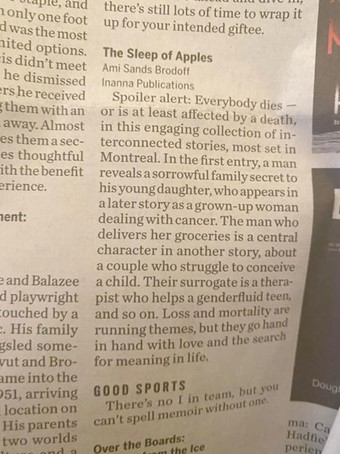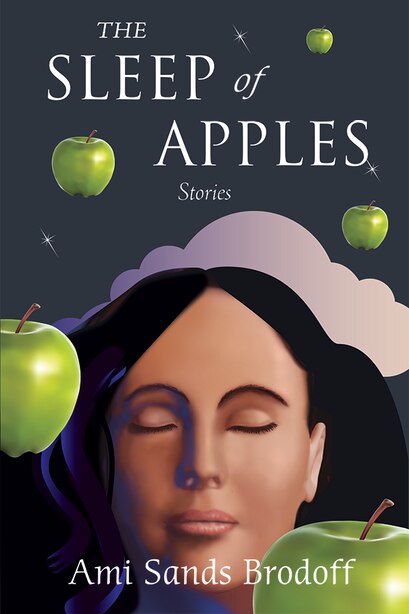
The Sleep of Apples is the story of nine, closely-linked characters who confront crises related to mental illness, mortality, and gender identity. Set in a gritty neighborhood that’s been slowly gentrifying over the past two decades, Saint-Henri, that runs along the Lachine canal in southwest Montreal, these protagonists and their loved ones navigate their lives and work to build a supportive community.
The title of my book comes from a powerful poem by Federico Garcia Lorca called “Gacela of the Dark Death.” Sailing on the boundaries of life, sleep, death, and immortality, this beautiful poem was the seed and inspiration for my linked collection. The stories dramatize how we all live imperfect lives; we love what we have and mourn what we’ve lost. We struggle to make our lives—and our deaths—meaningful.
In “The Arrangement,” Natalie and Guy can’t have children, and come up with the idea of asking Natalie’s best friend, Rachel, to become their surrogate mother. Guy’s relationship with both women changes forever.
“What’s Mine Is Yours” is the powerful story of Miri who discovers a long-kept secret about her beloved father when she is eight years old. He is her role model in becoming a psychiatrist.
In the title novella, Miri now middle-aged and grappling with advanced ovarian cancer, enlists the help of Guy, the grocery delivery man who brings her food each day, and becomes her closest link to the outside world, to aid her in what she envisions as an ideal chosen death.
Morgan, the gifted young artist in “Will the World Pause for Me?” sees things that are not there and hears voices tormenting her inside her head, but finds comfort with her best friend Collier who experiences their own struggles as a gender fluid, non-binary teen.
In “Brother’s Keeper,” Adán, a lonely Costa-Rican man raised in poverty in Tortuguero, tries for the umpteenth time to save his self-destructive, alcoholic brother, only to find a new direction in his own life through a bond forged with Katie, a young woman from Saint-Henri who has lost her mother. As he paves the way for Katie in his home village, Adán finds his own calling as guide and witness to the migration of the sea turtles, a wonder he has grown up with and that is an integral part of his identity.
Readers witness the characters gaining strength, insight, and empathy through their struggles and suffering. They each bear the scars of trauma, but possess the gift of resilience.
My mother hadn’t been feeling well. She’d developed a throat-clearing tic that seemed to come out of nowhere. We were all worried.
After a battery of tests, it emerged that mom had lung cancer. She’d been a smoker for a long time, but had quit decades earlier.
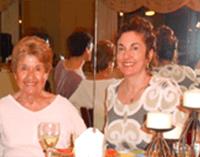
My relationship with my mom, a psychiatrist, had always been fraught and painful. She was a hypercritical woman with lofty expectations for her three children. It was hard to get her attention, even tougher, her approval. (Her own mother, my grandmother, Florence, had been even more daunting.) Busy, respected, and known in the community, my mom was one of the few professional working mothers in my group of friends, one of a tiny community of women in her medical school class at New York University. These were accomplishments I came to admire later on, as she provided me with a role model of a woman with a successful career.
Talking with my mom and her doctors, I knew that she did not have long to live. She was a person who did not like things being done to her body. I found out that she had been sexually abused—along with her identical twin sister—by their violin teacher. Even spa days did not appeal to her, let alone surgery, chemotherapy, and radiation. It was a hard no for further interventions.
Death is long and I felt an urgency to spend as much time with my mom as I could, and to heal our relationship if that was possible.
I visited often, making the six hour trip from Montreal to visit her in her apartment in New York. We had long talks, meals, a short walk if she could manage it. I shared feelings with her that I had never dared to share before. It didn’t always go over well. She was a real tough cookie.
One afternoon during winter, while we were sharing a cup of tea, she told me about a relationship she’d formed with a man who delivered food to her apartment from a small local grocery store. Apparently, he’d been a pilot. He’d deliver her meals and then sit with her to chat, sometimes for hours. They got close. She told me he was handsome. She told me he was at least twenty-five years her junior.
This little story glowed bright and got the fiction antennae in my brain buzzing. I was fascinated! Mom had a tantalizing secret life even near the end of her life. Though the title novella in The Sleep of Apples is transformed through imagination, my mother’s story was the seed.
“The Sleep of Apples” took multiple drafts to get right. Originally, I had alternating points-of-view between Miri and Guy and a great deal of backstory. As a novelist and fiction writer, I am definitely a putter-inner who hones in closer and closer to the heart of my stories which invariably includes a great deal of cutting and distillation. I ultimately decided to focus in on Miri. The epiphany came when I used the second person, Miri addressing Guy. This point-of-view provided such an intimate voice. After that, everything came together.
I gave the eulogy at my mom’s funeral and addressed her directly. I dream of her often and when I dream about her she is alive. Now that my mom is dead, she is with me all the time.
Adapted from The New Quarterly: The Writers’ Corner

Several key characters in The Sleep of Apples face death sooner rather than later.
Today, death has replaced sex as the final taboo. Yet mortality is 100 percent! Ars Moriendi is Latin for the “art of dying.”
Lydia Dugdale, the director of the Center for Clinical Medical Ethics and the Dorothy L. and Daniel H. Silberberg Associate Professor of Medicine at Columbia’s Vagelos College of Physicians and Surgeons, looks to the Middle Ages for wisdom on how to prepare for the end of life in her book The Lost Art of Dying. She points out that our modern reaction to death is pure unadulterated terror—and avoidance.
Interestingly, the philosophy of dying well developed during the aftermath of the bubonic plague that decimated Western Europe in the mid-1300s, points out Dr. Dugdale. Up to two-thirds of Europe’s population died during that plague. How to die well handbooks were created both by the church and the laity so people could prepare for death themselves without requiring a priest. In medieval Europe, memento mori, such as locks of hair, skulls, and hourglasses served as palpable reminders that death is inevitable.
These ideas are uncannily relevant now with the worldwide death toll caused by the COVID-19 Pandemic. Worldwide, there have been close to 4 million deaths due to Covid-19. It is hard to keep up: the numbers increase daily.
The main theme of ars moriendi is that to die well you need to live well. Recognizing your mortality and reflecting on your purpose and what is meaningful to you is key.
Dr. Dugdale says, “The ars moriendi was sometimes described in theatrical terms. Each death represents a drama. The dying person is the lead actor, and community members all play supporting roles.” Of course, each one of us is going to become the lead—the dying person—at some point, though we don’t know when. “People live and die much better,” she points out,“if they are part of a meaningful community.” Her advice: cultivate your relationships now while you are healthy and those bonds will be richer at the end of your life.
It’s vital to live with the knowledge of our own death, as well as that of our loved ones. This helps us value our time on earth.
Dr. Dugdale urges us to “rethink dying in a hospital, which is chaotic and expensive,” where both doctors and patients are tempted into overtreatment. Think about maximizing the quality—not just the quantity—of life.
Thankfully, here in Canada, medical assistance in dying, or MAID, is legal. We enhance our humanity by providing people with their end-of-life choice.
Many of the characters in The Sleep of Apples struggle with some form of mental illness, such as depression, anxiety, addiction, and the most severe form of mental illness, schizophrenia.
Mental illness is common and yet widely misunderstood. Take a look at the figures.
Here in Canada and the U.S.
Sadly, many people facing mental illness also confront stigma unlike those with a physical medical challenge, such as diabetes, heart disease or cancer. These prejudices only heighten the pain and obstacles facing the person grappling with mental illness and their families.
Educate yourself about mental illness and mental health. Respond with kindness, empathy, and support. It could be—and may well be—you or someone you love.
As a teenager, my younger son woke up one morning and said to me, “Mom, I slept the sleep of apples.” The phrase struck me with its mysterious beauty; I thought he’d made it up. Later on, I discovered it was from a Federica Garcia Lorca poem. “Gacela of the Dark Death” is a short lyric poem in free verse, twenty-four lines, divided into five stanzas. A “gacela,” a form perfected by the 14th Century poet Hafiz, the poem is written in the first person and speaks directly to the reader. Using repetition, it has the inexorable rhythm of waves breaking and battering the shore, sailing on the boundaries of life, sleep, death, eroticism and immortality. The poem and my collection dramatize how we all live imperfect lives. We love what we have and mourn what we’ve lost, struggling to make our lives—and our deaths—meaningful. The best poetry is bottomless: each time a reader dives down, new jewels of meaning surface. I used this poem as my epigraph, the seed and inspiration for my collection
Yes, The Sleep of Apples is definitely a hybrid straddling both the novel and short story forms. It’s a novel-in-stories, a ring of stories, centering on a group of characters leading intertwined lives. The challenge of the short story is making it short. As Henry David Thoreau said, “Not that the story be long, but it will take a long while to make it short.” Distillation, the containment of something large and powerful compressed into a small space, is what gives the short story its power. Finding the right voice and point-of-view is vital; stories are voice-driven. When I’m writing a novel, I struggle with finding its shape and structure, figuring out what goes where. I want to write the kind of novel I love to read, so I strive for fresh invigorated language, deeply layered characters, and an exciting story. I love lies, secrets, and surprises! Yet, I need to avoid melodrama, contrived situations, and coincidences. Turns of the plot have to be earned and credible even if they come as an electric shock to the reader. As my kids say, “It’s a lot!” I was drawn to this hybrid form in The Sleep of Apples, where meaning is achieved by the relationship of one story to another, by the echoes between them, creating a contained narrative pressure. The reader is active, finding their own meaning in the spaces between stories, because I’ve dispensed with the heavy exposition and backstory that weighs down some novels. The book eventually comes full circle, ending at the place where it began, which is not the same place it was, each character serving as a compass point on the journey.
Like Rachel, the recreation therapist in “Male and Female Created He Them,” I’m a breast cancer survivor. I’ve experienced the shock, loss, and change in body image that comes with a cancer diagnosis and treatment. Breast cancer is common: 1 in 8 women will get it. When I go through a painful experience in my life there is always the comfort and redemptive element of being able to write about it later. Later is the key word here, as perspective is key. I’m also the mom of a transgender son and a gay son and know many non-binary teens and young adults. I have a deep sense of some of the challenges that trans, non-binary, and gay teens go through and put that knowledge and empathy to use in creating Collier, one of the main characters in The Sleep of Apples. Rachel and Collier have a powerful unspoken recognition and bond based on experiences that are distinct but bear surprising commonalities.
I don’t write auto-fiction, and though I draw from my experience at times, it’s always transformed through perspective, empathy, and imagination. I also write about my obsessions, what keeps me up at night, what I can’t stop thinking about, which may require immersion, research, learning about a character or situation that is not literally sprung from my own life.
A few years ago, I lost my mother, my father, and my beloved other mother (I don’t like the term step-mother) in fairly rapid succession. Then the Covid-19 Pandemic hit. So impermanence and mortality were on my radar. Close to 4 million people have died worldwide from Covid-19 as I write and the numbers increase daily. Many survivors have lost loved ones and have not been able to honour and mourn them. Despite all the death surrounding us, death has replaced sex as the final taboo. Our reaction is still unadulterated terror–and avoidance. Yet mortality is 100 percent! As Miri says in the title novella, “we are all going to die but we don’t know when.” In spending time with my parents before their deaths, I became interested in the lost art of dying, how to help your loved ones prepare for death, how to prepare yourself for their death, and ultimately, your own. Interestingly, the philosophy of dying well developed during the aftermath of the bubonic plague that decimated Western Europe in the mid-1300s. Up to two-thirds of Europe’s population died during that plague. How to die well handbooks were distributed both by the church and the laity so people could prepare for death themselves. These ideas are uncannily relevant now as we struggle with the impact of the Covid-19 pandemic. In her book, The Lost Art of Dying, Lydia Dugdale, the director of the Center for Clinical and Medical Ethics at Columbia’s Vagelos College of Physicians and Surgeons, urges us to rethink our notions about dying. To die well you need to live well. Recognizing your mortality, reflecting on your purpose and what is meaningful to you is key. Think about maximizing the quality—not just the quantity—of life. Thankfully, here in Canada, medical assistance in dying, or MAID, is legal. We enhance humanity by providing people with their end-of-life choice, the crux of the title novella in The Sleep of Apples.
We can only pick so many causes in our lives. Reducing stigma against people struggling with mental illness is mine. Mental illness hits close to home. My oldest brother, whom I was very close to growing up (we shared a secret place, a private language; I was his sidekick, he was my protector) has struggled with schizophrenia, the most severe form of mental illness, since adolescence. In addition, my late father-in-law had schizophrenia, and my late mother-in-law, a survivor of three concentration camps, suffered from what we now know as post-traumatic-stress disorder, or PTSD. I’ve had my own battles with anxiety and depression. Throughout my life, I’ve seen first-hand the stigma that mentally ill people and their families go through and the silence and secrecy, the shame and blame, that surrounds mental illness. When my brother was becoming ill, the cruel behavior of other kids, but even of teachers and doctors, came as a shock. Struggling with mental illness is hard enough; stigma only adds to the pain. A number of my characters in The Sleep of Apples grapple with mental illness, such as schizophrenia, depression, anxiety, and survivor guilt. Mental illness is common with 1 in 5 people affected each year. Schizophrenia is about as common as diabetes, but gets far less empathy. My hope is that readers will immerse themselves in my characters and their stories and that The Sleep of Apples will raise awareness, empathy, and reduce stigma for people struggling with mental illness.
BIG NEWS! THE SLEEP OF APPLES IS HONOURED AS A FINALIST FOR THE 2022 INTERNATIONAL BOOK AWARDS!
THE SLEEP OF APPLES FEATURED IN CBC’S LIST OF RECOMMENDED TITLES FOR JEWISH HERITAGE MONTH!
SUPERB REVIEW OF THE SLEEP OF APPLES IN HERIZONS, SPRING ISSUE: “AMI SANDS BRODOFF’S WRITING IS LIKE A SEA TEEMING WITH LIFE. DARE TO WADE INTO IT AND YOU WILL DISCOVER, AS THE CHARACTER MIRI DOES, THAT YOUR “HEART IS BURSTING, MIND FLOATING FREE.”
IN THE RENDERING UNCONSCIOUS, A PODCAST ABOUT THE INTERSECTION BETWEEN PYSCHOLOGY, PHILOSOPHY AND THE ARTS, AMI TALKES WITH PSYCHOANALYST DR. VANESSA SINCLAIR ABOUT HER NOVEL-IN-STORIES, THE SLEEP OF APPLES
THE SLEEP OF APPLES IS SELECTED BY POSTMEDIA FOR THEIR BEST BOOKS HOLIDAY GIFT LIST: “TOME FOR THE HOLIDAYS.”
The capsule review appears in dozens of papers across Canada including the National Post, The Montreal Gazette, The Ottawa Citizen, Regina Leader Post, Vancouver Sun, Edmonton Journal, Calgary Herald, Recorder and Times, Windsor Star, among others.
READ IT HERE:
AMI IS IN CONVERSATION WITH MARK LESLIE LEFEBRE ABOUT ALL THINGS APPLES, HER WRITING PROCESS AND CAREER PATH FOR HIS PODCAST: STARK REFLECTIONS ABOUT WRITING & PUBLISHING. LISTEN HERE:
SUPERB REVIEWS OF THE SLEEP OF APPLES ON THE ‘GRAM
FOR THE ELEANOR LONDON COTE SAINT-LUC LIBRARY, AMI TALKS ABOUT THE SLEEP OF APPLES, FAMILY SECRETS, AND SHARES TWO EXCERPTS FROM HER NOVEL-IN-STORIES
AMI & THE SLEEP OF APPLES FEATURED IN “I’VE GOT QUESTIONS”:
Listen in on the interesting and fun conversation between Ami and novelist Cliff Garstang which includes the foods and music in The Sleep of Apples.
AMI AND THE SLEEP OF APPLES FEATURED ON PODCAST NOVELIST SPOTLIGHT
Tune in and listen to an in-depth chat between Ami and Mike Consol on his podcast Novelist Spotlight. You’ll learn why Ami writes, get inside knowledge about her inspiration, process, and the story behind the stories in The Sleep of Apples. The conversation can be heard on Spotify, Google podcasts, Apple podcasts, Pandora, Podomatic, and YouTube. Here are the links. Enjoy!
THE SLEEP OF APPLES IS FEATURED IN QUILL & QUIRE’S SPECIAL NOVEMBER ISSUE ON GREAT CANADIAN SHORT FICTION.
Pick up a copy at your local newsstand or check out the issue online
THE SLEEP OF APPLES RECEIVES EXCELLENT REVIEW IN THE MIRAMICHI READER:
“Brodoff excels in her treatment of …incredibly complex and delicate subjects, navigating the different feelings of her characters and their opposing viewpoints with compassion and sensitivity. The Sleep of Apples is a wonderful read….”
NOVELIST AND BOOK SHOW HOST ALICE KUIPERS RECOMMENDS THE SLEEP OF APPLES ON HER MORNING SHOW ALI’S BOOK CLUB ABOUT NEW READS @ CTV
THE SLEEP OF APPLES IS CHOSEN BY CANADIAN LIVING FOR THEIR FALL 2021 BOOK CLUB.
THE AUTHORS BOOK CLUB FEATURES THE SLEEP OF APPLES AND AN IN-DEPTH INTERVIEW WITH AMI ABOUT HER INSPIRATION, WRITING PROCESS & PRACTICE, AS WELL AS HER CAREER PATH
CBC FEATURES THE SLEEP OF APPLES IN THEIR LIST OF MOST ANTICIPATED FALL FICTION TITLES
THE 49TH SHELF RECOMMENDS THE SLEEP OF APPLES AS ONE OF THEIR MOST ANTICIPATED FALL FICTION TITLES
Ami and The Sleep of Apples is featured on the new podcast with Richard King: Something About Writing
THE SLEEP OF APPLES is a Recommended Fall Title at RE:BOOK